“We will never rent or sell your data” is a promise about a transaction, not about a glance. It tells you what Grammarly will not do with your writing. It does not tell you what the app must look at to correct a sentence, how long it keeps any of it, or whether any of it trains a model.
That gap is not a criticism of this company in particular. It is the shape of almost every keyboard or writing app’s privacy claim, and it is worth knowing how to read one.
What the listing saysTwo sentences, one of them narrow
Grammarly keyboard, app description.
Same description.
Read the second with the first. “Privacy by design” is a method claim — it says architecture was considered. “Never rent or sell” is a commercial claim — it says money will not change hands for your text. Neither is a retention claim, an access claim, or a training claim. Those are three different things, and none of them is answered here.
What has to be true for the correctionThe mechanics the sentence quietly assumes
It has to see the words, in order, as you type
The listing is candid about the plumbing: “Designed to deliver real-time writing feedback and provide AI assistance, the Grammarly Keyboard works directly in your iPhone and iPad apps, no copy and paste required.” Real-time feedback on a sentence you are still writing means the sentence is being read while you write it. Whether that happens on the device or on a server is not stated in the description — and that single fact is the whole privacy question.
“AI assistance” is the part that moved
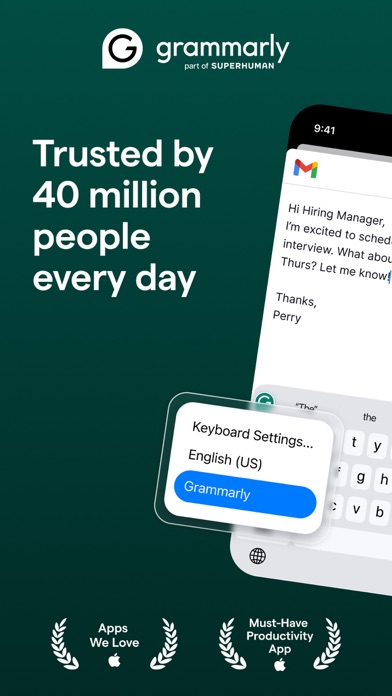
The description in this record advertises AI features and is published under a seller line that now reads Superhuman, with the store image carrying the same name. A keyboard that used to check grammar now also writes for you. Products change hands and change scope; what stays useful is the habit of reading who publishes the thing you type into.
Read it as a set of limitsWhat is claimed, and what is not
- No sale or rental of your text to third parties.
- Integration at the keyboard, so the app is present in every field you fill.
- Not claimed: how long typed text is stored anywhere.
- Not claimed: whether anything is retained when you delete a document or unsubscribe.
- Not claimed: whether your writing improves any model, including after you pay.
- Not claimed: what the app sees in fields you would rather it did not — passwords, one-time codes, other people’s quoted emails.
What a keyboard is, structurallyNot an app you open, a layer over everything else
“Instantly and easily create smart, polished writing with the Grammarly Keyboard.” is a sentence about convenience, and the convenience comes from a specific architectural fact that is worth stating plainly: a keyboard is not an app you switch to. It is the thing sitting between you and every text field in every other app — mail, messages, the bank’s notes field, the form on a laptop you borrowed.
That is why the same product described as a writing aid behaves, from the operating system’s point of view, like a component with unusually wide reach. It is also why the interesting question about a keyboard is never “is the suggestion good” but “what does this layer see, and what does it do with it”. A store description answers the first question. It is not the document that answers the second.
The test you can run yourself
Do not take anyone’s word for the architecture, including this page’s. On the device, open the keyboard’s own settings and turn off the separate permission that a third-party keyboard needs in order to send anything anywhere. Then type something with an obvious error in a normal app. If corrections stop appearing, you have just learned where the judgement is made — not from a marketing line, and not from a screenshot in a review. Put the permission back the same way when you are done, since the keyboard is otherwise crippled.
Two layers of claimWhat is said, and what would need a different document
“Privacy is our priority Grammarly practices privacy by design.” and “Your words are your own; we will never rent or sell your data.” are, as written, statements about the company’s intentions and about one specific transaction: sale. Nobody disputes that a firm can honour “we do not sell it” while still processing text on its servers — those are different claims, and reading the second as the first is the most common mistake people make with this category of product.
- It does not say in the listing how long anything is retained, or whether retention differs between free and paid accounts.
- It does not say whether text is used to improve models, and if so, whether that is on by default or something you can decline.
- It does not say what an organisation’s administrator can see if the account is issued by an employer rather than bought personally.
- It does not say which suggestions are produced on the device, which is exactly the question the test above answers for your own setup.
None of that is an accusation; a store description is a bad place to put a data-retention schedule, and the length of that list mostly reflects what the format cannot carry. The consequence for you is narrower and more useful: the claims are not the mechanism, and the mechanism is checkable in about thirty seconds.
Whose money, and whose accountThe two subscription sentences
Grammarly’s listing, in its subscription terms.
“Your subscription will automatically renew unless you cancel at least 24 hours before the end of the current period.” That is the deadline, and it is not the last day. But the first sentence is the one that surprises people in shared households: the charge belongs to whatever account your Apple ID is tied to, so a trial started on a teenager’s phone can bill a parent, and a plan bought on a work phone is entangled with a personal ID in a way that becomes awkward on the day the phone is handed back.
- Check which Apple ID is signed in before starting a trial, not afterwards when the statement is confusing.
- If the account was issued or paid for by an employer, treat anything you type on that keyboard as potentially visible to their administrators.
- Set a calendar reminder for 48 hours before any renewal date — the “at least 24 hours” buffer exists so that a same-day decision can fail.
The thing nobody warns you aboutEleven people sending the same email
A grammar check fixes a comma. A style suggestion replaces a clause with something smoother, and there is no reason to think the smoother version is worse. The odd effect appears only at scale: when a suggestion is good enough to be accepted by thousands of people in the same week, the accepted version becomes the house style of a whole industry’s inbox, and individual voice erodes quietly rather than being taken away.
That is our reading, not a claim from the listing, and it is not a reason to uninstall anything. It is a reason to notice the moments where a suggestion makes your message sound like everybody else’s — the opening sentence of a pitch, the apology that arrives pre-forgiven, the decline that no longer sounds like you declining. Those are the places where keeping your own clumsy phrasing is a decision with a point, and the tool has no view on it either way.
What not to type through anyone’s keyboard
Passwords and one-time codes are the obvious answer, and the least interesting. The list that actually matters in practice is shorter than people expect: a client’s confidential details in a mail you are drafting at the kitchen table; a patient’s or a child’s information in a message to a school; anything from a legal or medical thread you would not want stored with metadata attached; and any text written by another person who never agreed to have it sent anywhere for checking. The last one is the category people miss — the forwarded message you paste in to have tidied is somebody else’s words, and they did not consent to your tool.
We are reading a store description, not the company’s privacy policy or its help centre, neither of which was available to us while writing this. So nothing above says Grammarly keeps, sends, or trains on anything — only that the listing does not say. Those three answers exist, in plain language, in the policy the company publishes; they take about four minutes to read and they will not agree with the slogan in every particular. Treat the gap as the point of the article, not as an accusation.
The practical partFour habits that do not need an answer
- Leave the keyboard off for anything whose confidentiality depends on nobody reading it: legal drafts, medical detail, credentials, other people’s messages pasted in to be summarised.
- Turn the keyboard off where a code or password is typed. Most systems already do this for password fields; do not assume it covers the one-time-code box on a bank page.
- If you pay, remember the renewal is held by the store, not by the app. The listing’s own instruction is that “After purchase, you can manage your subscription by going to your account settings in the App Store.”
- Decide once, per type of text, rather than per message. “Work email, yes; anything with a case number, no” is a rule you can keep. A case-by-case judgement at 11pm is not.
- Every quoted sentence — the app description supplied by the publisher of this record, retrieved from the store’s public catalogue interface and compared word for word with this page. The seller line and the branding inside the screenshot are quoted because they are visible, not because we have inferred a company history.
- One store image — supplied by the developer, captioned for what the frame shows and what it does not.
- Our own reading — the split between commercial, architectural and retention claims, and the four habits. Not the vendor’s words.
The app’s page on this site is here, next to the keyboard and writing tools on the tools and devices hub. If you want the wider version of this question — which messaging apps mean what by “private” — it is here.
Written by the Dlzer editorial desk. Not affiliated with, endorsed by or sponsored by Grammarly, Superhuman or Apple. Names and marks belong to their owners and are used to identify the product; quoted lines are the publisher’s own statements about its app, reported and not adopted.